
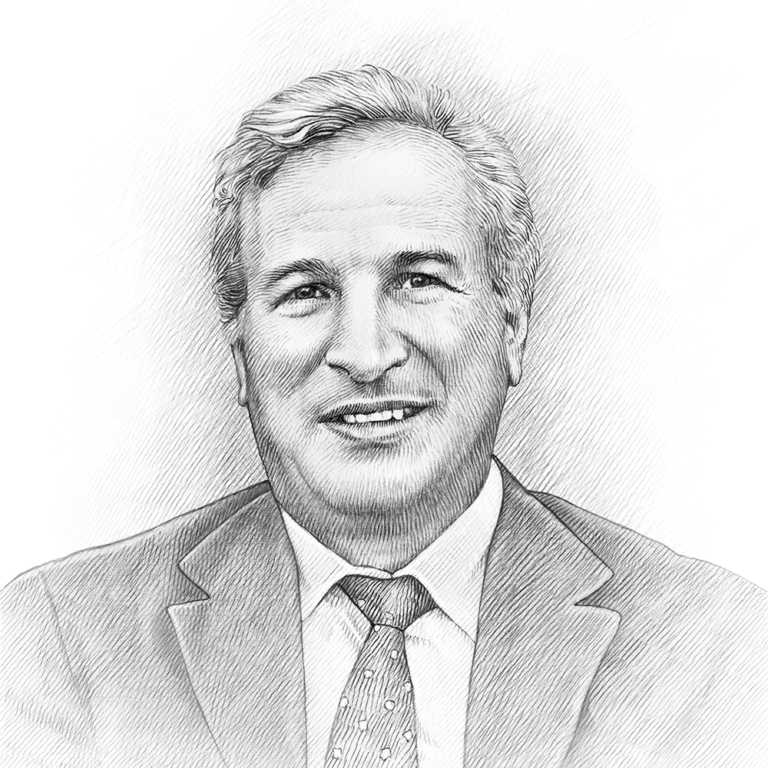
Professor Moh’d Wahib Hussein
King Faisal Prize in Islamic Studies 2026 Laureate
Topic: "Trade Routes in the Islamic World"
Moh’d Wahib Hussein was born in Amman, Hashemite Kingdom of Jordan, in 1962. He earned his bachelor’s degree in archaeology from the University of Jordan in 1984, and his master’s degree from the same university in 1988. He continued his training with foreign archaeological missions from Canada, Europe, the United States, and Japan, alongside his academic studies. He earned his Ph.D. from Hacettepe University in Ankara, Turkey, in 1991.
He joined the Department of Antiquities in Amman, where he established the Cultural Resources Management program to serve as a foundation for managing cultural heritage using modern technologies and applying this approach across the Arab world. He supervised excavation and survey projects in the field, including the discovery of the Baptism site (Al-Maghtas), the identification of ancient road networks, and the Islamic palace of Al-Muwaqqar. His work led to several discoveries that supported social, economic, and cultural development in local communities.
Professor Wahib’s research focused heavily on excavations and field studies, especially in the area of technology related to metal production, with a particular focus on copper. He identified ancient manufacturing centers in Wadi Arabah and Feynan, as well as the old trade routes connected to these centers. He helped establish the study of archaeometallurgy in Jordan and published several articles and books on copper mining, its ores, and its production methods throughout history.
His work also concentrated on locating sites of global significance, most notably the discovery of the Baptism site of Jesus (Al-Maghtas) on the eastern bank of the Jordan River. The site was recognized by the UNESCO World Heritage List in 2015.
Professor Wahib authored more than one hundred peer-reviewed scientific articles and 56 specialized books organized as academic series. His research has produced discoveries of global, regional, and local importance. He discovered forty major findings, including the discovery of the Long Jordan Wall in 2021; the discovery of the homeland of the Prophet Lot on the eastern shore of the Dead Sea along the route of the Elaf Road in 2017; the discovery of the Midian civilization in 2020; and the identification and documentation of historical routes using aerial imaging, such as the Christian Pilgrimage Route in 2023, the International Incense Trade Route, and the Makkah Elaf Route between 2023 and 2024.
He received many awards and certificates of appreciation, including the Abdul Hameed Shoman Regional Award for Young Arab Researchers in 2000; the Distinguished Researcher Award at the Hashemite University in 2007; the Distinguished Researcher Award from the Association of Italian Tourism Organizations, Piacenza in 2012; the Innovation and Excellence Award at the Hashemite University in 2014; and the Special Medal for Arab Inspiring Figures in Dubai in 2024.